

There is no single answer to the question of how helium is measured. A gas supplier needs to know how much gas is left in a cylinder or dewar. A laboratory has to confirm purity. A process engineer needs the helium content of a mixture with nitrogen or air, while a quality engineer looks for the flow of helium through a microscopic leak. Each of these tasks relies on its own instruments and its own physical principles.
The difficulty is that helium hardly reacts with anything, does not burn and does not absorb infrared radiation. Many familiar gas sensors simply cannot detect it. Helium measurement therefore relies on physical quantities: pressure, mass, thermal conductivity and atomic mass. For continuous monitoring of the helium content of a process gas, an industrial helium analyzer can be used, providing a concentration reading without sending samples to a laboratory.
This article covers the four main tasks: measuring quantity, concentration, purity and leak rate. For each one, it describes the methods, their principles and their limitations.
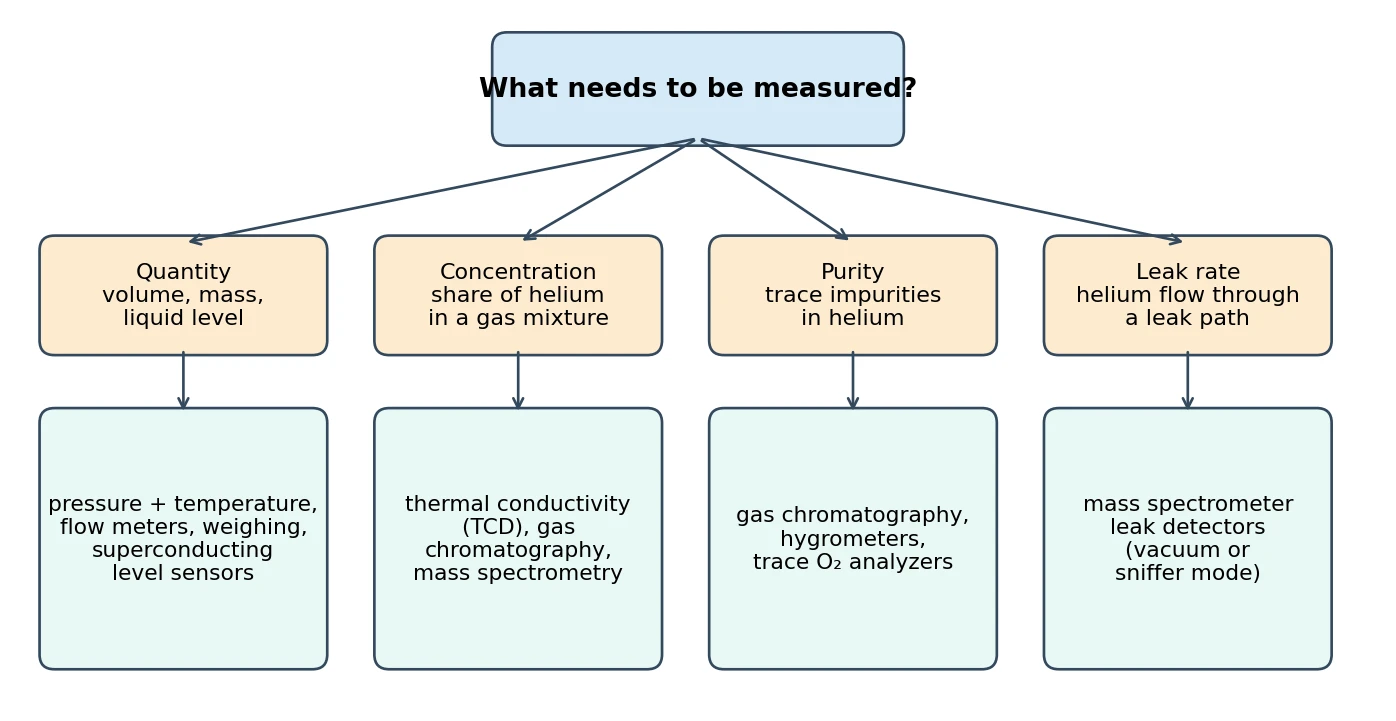
Fig. 1. What exactly is measured when it comes to helium, and which methods are used for each task.
Alt text: diagram of four helium measurement tasks: quantity, concentration in a mixture, purity and leak rate, with the methods used for each task
Why Helium Is Difficult to Measure
Most industrial gas sensors rely on the chemical or optical activity of the gas. An electrochemical sensor registers the current produced by a redox reaction. A catalytic sensor measures the heat released when the gas burns on a catalyst. An NDIR infrared analyzer detects the absorption of radiation at characteristic wavelengths.
Helium fits none of these principles. As an inert monatomic gas, it does not react under normal conditions, does not burn and has no absorption bands in the infrared range. Methods based on other properties are therefore used.
- Thermal conductivity. Among gases, only hydrogen conducts heat better than helium. The thermal conductivity of helium is roughly six times that of nitrogen and air.
- Low atomic mass. A helium atom has a mass of 4 u. In a mass spectrometer, the signal at this mass is easy to separate from the signals of the main components of air.
- Physical state. The quantity of gaseous helium is determined from pressure, temperature and volume; the quantity of liquid helium from its level or mass.
- Chromatographic retention. In a chromatographic column, helium elutes as a separate peak that a detector can register.
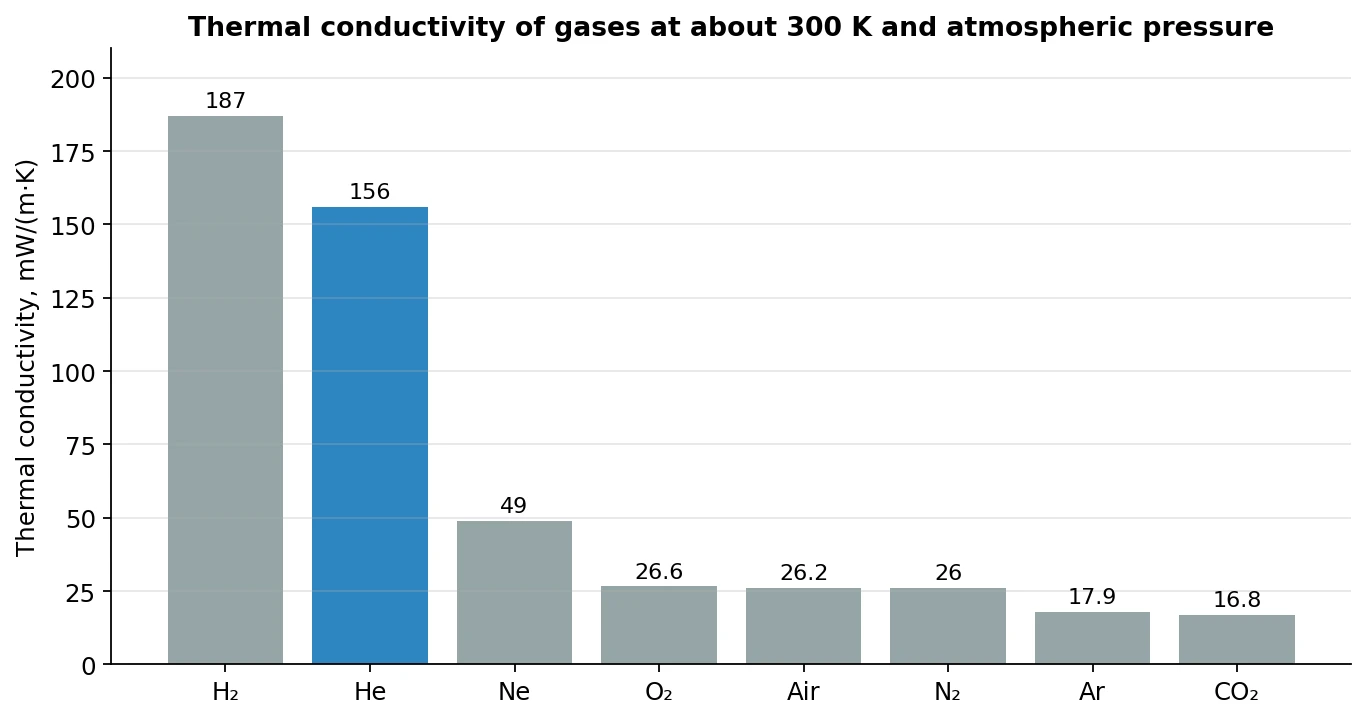
Fig. 2. Thermal conductivity of helium compared with hydrogen, neon, the main components of air, argon and CO₂ at about 300 K.
Alt text: bar chart of the thermal conductivity of gases: hydrogen, helium, neon, oxygen, air, nitrogen, argon and carbon dioxide; helium ranks second after hydrogen
Measuring the Quantity of Helium
Gas in Cylinders and Pipelines
The amount of compressed helium in a cylinder is estimated from pressure and temperature. At constant temperature, the remaining gas is roughly proportional to the pressure. At high pressure, however, helium deviates noticeably from ideal gas behaviour: its compressibility factor is greater than one. For accurate accounting, tables or equations of state are used rather than a simple proportion.
In pipelines, the quantity of helium is determined with flow meters. The low density of helium must be taken into account when selecting one: instruments calibrated for air or nitrogen require a correction or a separate calibration for helium. This is particularly important for thermal and thermal mass flow meters, whose signal depends on the thermal properties of the gas.
Units of account differ between markets. In the United States, helium volumes are usually given in cubic feet; in Europe, in cubic metres under standard conditions. Liquid helium is accounted for in litres or kilograms. One litre of liquid helium yields about 700 litres of gas at 0 °C and atmospheric pressure when it evaporates.
Liquid Helium in Cryostats and Dewars
The level of liquid helium is most often measured with a superconducting level sensor. The sensor is a thin wire of a superconducting alloy suspended in the vessel. The part of the wire immersed in the liquid remains superconducting. The part above the liquid is heated by the measuring current and becomes normally conducting. The resistance of the sensor is proportional to the length of wire above the liquid, and the level is calculated from it.
Transport dewars are also weighed. The difference in mass before and after filling shows how much liquid helium has been transferred, and monitoring the mass during storage reveals boil-off losses.
Measuring Helium Concentration in a Mixture
Helium concentration is measured wherever helium is mixed with another gas: in recovery and reuse loops, in leak test mixtures, in breathing gases and in plants that extract helium from natural gas. Three groups of methods are used for this purpose.
Thermal Conductivity Detection (TCD)
A thermal conductivity detector (TCD) measures how much heat the gas draws away from a heated sensing element. The higher the helium content of the mixture, the more heat is removed. There is no chemical reaction with the gas, so the sensor is neither consumed nor poisoned.
The method is suitable for continuous inline measurement. Depending on the sensor design, gas pair and calibration, TCD analyzers cover tasks ranging from low helium concentrations to nearly pure gas.
The method has a fundamental limitation: thermal conductivity reflects the properties of the mixture as a whole, not of a single component. It is therefore designed for binary and quasi-binary mixtures, such as helium in nitrogen, helium in argon or helium in air. If the proportion of a third component changes, the signal changes with it. The calibration is always tied to a specific gas pair.
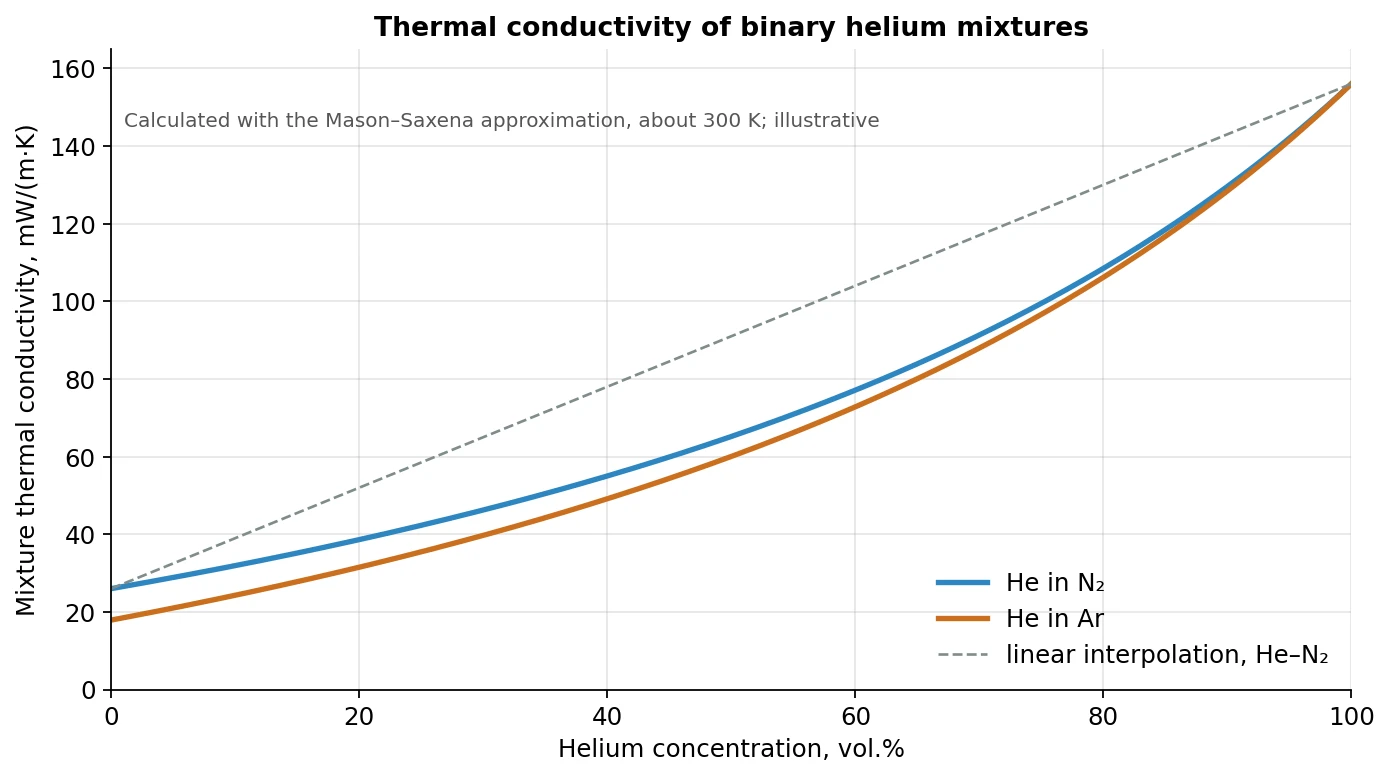
Fig. 3. The thermal conductivity of a mixture depends non-linearly on the helium concentration and differs between background gases. Calculated with the Mason–Saxena approximation; illustrative.
Alt text: graph of the thermal conductivity of helium–nitrogen and helium–argon binary mixtures as a function of helium concentration, showing a non-linear relationship compared with linear interpolation
The graph illustrates two practical points. The relationship between signal and concentration is non-linear, so the analyzer uses a characteristic curve obtained during calibration. In addition, at the same helium content, mixtures with nitrogen and with argon have different thermal conductivities, so a calibration for one pair cannot be transferred to another.
The result is affected by the pressure and temperature of the gas at the measuring point. Pressure fluctuations are either stabilised or compensated using readings from a pressure sensor. The sensor temperature is kept constant.
Gas Chromatography
A gas chromatograph separates the mixture in a column and quantifies several components, including helium. There is one particular feature here: helium is often used as the carrier gas. To measure helium itself, argon or nitrogen is used as the carrier, and helium is registered by a thermal conductivity detector.
Chromatography provides an accurate composition for several components, but it works in cycles and requires sampling. It is used for laboratory analysis, acceptance testing and exploration, where the helium content of natural gas is determined.
Mass Spectrometry
A mass spectrometer ionises the gas and separates the ions by their mass-to-charge ratio. The signal at mass 4 corresponds to helium. The method is sensitive and selective, so it is used for low concentrations, including helium at the atmospheric background level (about 5 ppm), in geochemical studies and in leak detection. It requires a vacuum system, and the gas is fed into the instrument through a sampling system.
Comparison of Concentration Measurement Methods
| Method | Principle | Operating mode | Typical tasks | Limitations |
| Thermal conductivity (TCD) | heat removal from a heated element | continuous, inline | helium recovery loops, test mixtures, breathing gases | binary and quasi-binary mixtures only, pressure must be taken into account |
| Gas chromatography | separation of components in a column | cyclic | laboratory analysis, acceptance testing, exploration | sampling, discrete result |
| Mass spectrometry | separation of ions by mass | continuous or cyclic | low concentrations, geochemistry, leak detection | vacuum system, sampling |
Measuring Helium Purity
Helium purity is expressed as a grade. European practice uses designations such as 4.6, 5.0 or 6.0: the first digit gives the number of nines, the second gives the last digit. Grade 5.0 corresponds to a helium content of at least 99.999 vol.%, and grade 6.0 to at least 99.9999 vol.%.
At such purity levels, it is not helium itself that is measured but the impurities. Each is specified separately, usually in ppm or ppb. Typical impurities monitored include nitrogen, oxygen, moisture, hydrogen, neon, carbon monoxide, carbon dioxide and hydrocarbons.
- Gas chromatography with sensitive detectors determines permanent gases and hydrocarbons at sub-ppm levels. For trace concentrations in helium, a pulsed discharge helium ionisation detector is one of the options used.
- Hygrometers measure moisture, usually as dew point.
- Trace oxygen analyzers monitor oxygen in inert gases.
Thermal conductivity measurement is also used for real-time monitoring downstream of purification units. It shows the helium content of the stream and signals ingress of air or nitrogen, but it does not identify individual impurities and does not replace analysis against a grade specification.
Measuring Leak Rate
In leak testing, helium serves as a tracer gas. What is measured is not concentration but the flow of helium through a leak. Leak rate is expressed in mbar·l/s or Pa·m³/s.
Mass spectrometer leak detectors tuned to mass 4 are used for this purpose, in several modes.
- Vacuum mode. The test object is evacuated and connected to the leak detector, and helium is sprayed onto its outer surface, or the object is placed in a chamber filled with helium. This mode offers the highest sensitivity.
- Sniffer mode. The object is filled with helium or a helium–nitrogen mixture under pressure, and the operator moves a sniffer probe along welds and joints. Sensitivity is limited by the background helium content of the air.
- Accumulation mode. The object, pressurised with helium, is placed under a hood, and the leak detector measures the rise in helium concentration in the enclosed volume over a set time.
A leak detector answers the question of whether there is a leak and how large it is. It does not show the helium concentration of the mixture used to fill the test objects. Monitoring the composition of the test mixture requires a separate instrument that measures concentration.
Where Helium Concentration Measurement Is Needed
| Task | Gas pair | What is monitored |
| Helium recovery and reuse | helium in nitrogen or air | helium content of the collected gas, purification efficiency |
| Leak testing | helium in nitrogen or air | composition of the test mixture, filling of test objects |
| Breathing gas preparation | multi-component mixture of helium, oxygen and nitrogen | helium content of heliox and trimix, taking the oxygen content into account |
| Optical fibre and semiconductor production | helium in process gas | helium content of streams sent for recirculation |
| Helium extraction from natural gas | helium in nitrogen and other gases | concentration at the separation and purification stages |
| Shielding gas welding | helium in argon | composition of the shielding gas mixture |
In diving, for example, the oxygen content of trimix is checked with an electrochemical sensor, while the helium content is determined with a portable thermal conductivity analyzer that takes the composition of the gas mixture into account. In industry, the same physics is applied in stationary analyzers installed in the line.
How to Choose a Method for Measuring Helium
Before selecting an instrument, it helps to answer a few questions.
- What do you need to know? Quantity of gas, concentration in a mixture, purity or leak rate. The answer determines the class of instrument.
- What components make up the mixture, and how stable is its composition? For thermal conductivity measurement, this is the key question.
- What concentration range is required? Trace levels, medium concentrations or high-purity helium.
- Is a continuous signal needed, or is periodic analysis sufficient? Process control usually calls for a continuous signal, acceptance testing for periodic analysis.
- What are the pressure and temperature at the measuring point? This determines whether inline installation is possible and whether pressure compensation is needed.
- How will the signal reach the control system? Via an analog output, a digital interface or both.
- How will calibration be carried out? Calibration gas mixtures must match the gas pair for which the instrument is configured.
Frequently Asked Questions
Can helium be measured with an electrochemical sensor?
No. An electrochemical sensor registers the oxidation or reduction of a gas at an electrode, and helium does not take part in such reactions. Helium is measured by thermal conductivity, chromatography or mass spectrometry.
Why can helium not be used as the carrier gas when measuring helium by gas chromatography?
A thermal conductivity detector registers the difference in thermal conductivity between the sample and the carrier gas. If helium is the carrier, the helium peak in the sample cannot be distinguished from the baseline. Argon or nitrogen is therefore used to determine helium.
Can a TCD analyzer calibrated for helium in nitrogen be used for a helium–argon mixture?
Not without a separate calibration. Nitrogen and argon differ in thermal conductivity, so the same helium content produces a different signal. Some analyzers store several calibrations and can switch between gas pairs.
How does moisture affect thermal conductivity measurement?
Water vapour changes the thermal conductivity of the mixture and acts as a third component. If the moisture content of the gas fluctuates, its influence is taken into account in sample conditioning or when setting up the measurement.
Why can sniffer mode not detect the smallest leaks?
Atmospheric air contains about 5 ppm of helium. The sniffer registers this background together with the helium escaping from the leak, which limits the smallest detectable leak rate. Vacuum mode is used for the smallest leaks.
Conclusion
The way helium is measured depends on the task. The quantity of gas is estimated from pressure, flow or mass, and the level of liquid helium with superconducting sensors. Purity is verified through impurities using chromatography and specialised analyzers. Leak rate is measured with mass spectrometer leak detectors. For helium concentration in a mixture, chromatography, mass spectrometry and thermal conductivity measurement are used. Thermal conductivity measurement is particularly well suited to continuous inline measurement when helium is present in a binary or quasi-binary mixture and the calibration matches that gas pair.